“The faithful historian delineates characters truly, let the censure fall where it will.” John Adams to Mercy Otis Warren, March 1775
As commemorations for the 250th anniversary of the Declaration of Independence have unfolded, the question I keep coming back to is: what happens on July 5?
The last few months have been a flurry of activities, designed to elevate the stories of the Revolution and Founding for different audiences, and like a fireworks finale, July 4 feels conclusive. We can pack up our primary sources and go home.
The Declaration was a crescendo, and the semiquincentennial should be, too. Drafting language of independence was a complex decision that was weighed, argued, and championed after years of conflict with the British government. The Continental Congress did not know what would come next, but they understood that independence was a risk.
The years that followed 1776 were not a resounding success, or a simple, unified path toward nationhood. These were not superheroes but humans trying to make sense of the world, and the decisions made 250 years ago should exist as concurrent truths for those of us in 2026: there was brilliance, and there were flaws. There was no perfection, and no completion.
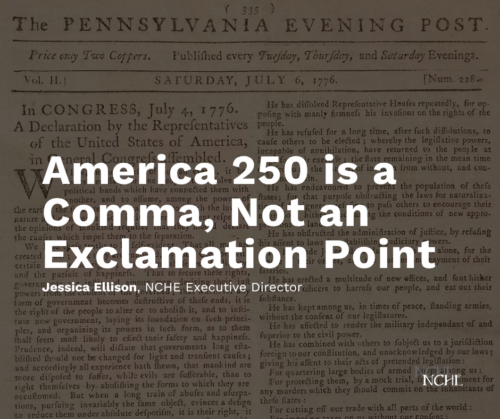
If our learning uses the Declaration of Independence as an exclamation point and not a comma, we are not giving the Founders or any of the founding documents their due. The Continental Congress knew that independence wasn’t the end. They knew that winning the war didn’t mean they could all just go home and resume routines. And the people that were legally and socially left out of “all men are created equal” knew the resoluteness of the strict hierarchies that governed their world.
I propose that July 6, 1776 be our beacon as we continue to understand the impact of the Declaration. Two days after it was adopted, the text of the Declaration began appearing in newspapers. The words no longer lived solely behind Congress’s closed doors; now, the document was in the hands of the people, and the people reacted in a multitude of ways. Yes, some felt joy and pride, but others felt betrayed and angry, and others questioned their own access to “life, liberty, and the pursuit of happiness.” This is a lesson of America: we have a shared past, experienced differently.
For history educators, America 250 has just begun. In our classrooms, we can ensure that the Declaration has left the “Committee of Five” and is circulating amongst a diverse population, all of whom are interpreting with different lenses and whose descendents will hold the document and its government accountable for two centuries. We should be compelled to revisit the learning of the last several months and expand upon it: How did the new government evolve? How did those who opposed independence react after the war? How did laws confirm or deny the Declaration’s principles? How did women, Black Americans, Indigenous people, and immigrants claim seats at the table?
Let us commit to an extended commemoration, one that acknowledges the milestones … and pays attention to the nuances in between … and chases after the promises we have yet to keep.