Space Age on the Space Coast

A National Endowment for the Humanities Landmarks Grant Program

overview

The National Council for History Education invites K-12 educators from across the United States to apply for “The Space Age on the Space Coast,” a unique professional opportunity that will immerse participants in the political, cultural, and scientific history of the Cape Canaveral region of central Florida.

This NEH Landmarks workshop will be offered two times: July 12-17, 2026, and July 19-24, 2026. The Astronauts Memorial Foundation on the campus of the Kennedy Space Center will serve as participants’ “home base.” While there you will have the opportunity to interact with historians, education specialists, master teachers, and NASA astronauts, launch directors, and engineers.

Before you apply, review the information below, including the Eligibility Requirements and Expectations, Application Deadlines, and the Application Checklist. Ready to begin your application? Click the “Apply Now” button located below the Application Checklist.
Historical Context

The Space Coast is—first and foremost—the starting point for America’s exploration of the universe, but the region also provides visitors with the opportunity to investigate the intersections of race, gender, politics, technology, and the environment.

The history of Florida’s Space Coast as an iconic landmark dates back to the 1950s, although humans have called this place home for at least eight thousand years.

When Europeans first visited the Florida Coast in the sixteenth century, Indian River Lagoon, which surrounds the Kennedy Space Center on three sides, was inhabited by the Ais, a small group of Indigenous hunters and gatherers.

By the nineteenth century, white settlers began to plant citrus on Merritt Island (on land just north of where the Space Center sits today), establishing what is now the Indian River Citrus District.

Henry Flagler’s Florida East Coast Railroad arrived in nearby Cocoa in 1893, bringing visitors and new public facilities, as well as increased opportunities for shipping local agricultural products.
Despite these developments, the region’s population remained small through the eve of the Space Race.

Beginning in the 1950s, politics, science, and culture collided in this unique geographical area as a result of the Cold War; they continue to intersect there in profound ways today.

Workshop Experience

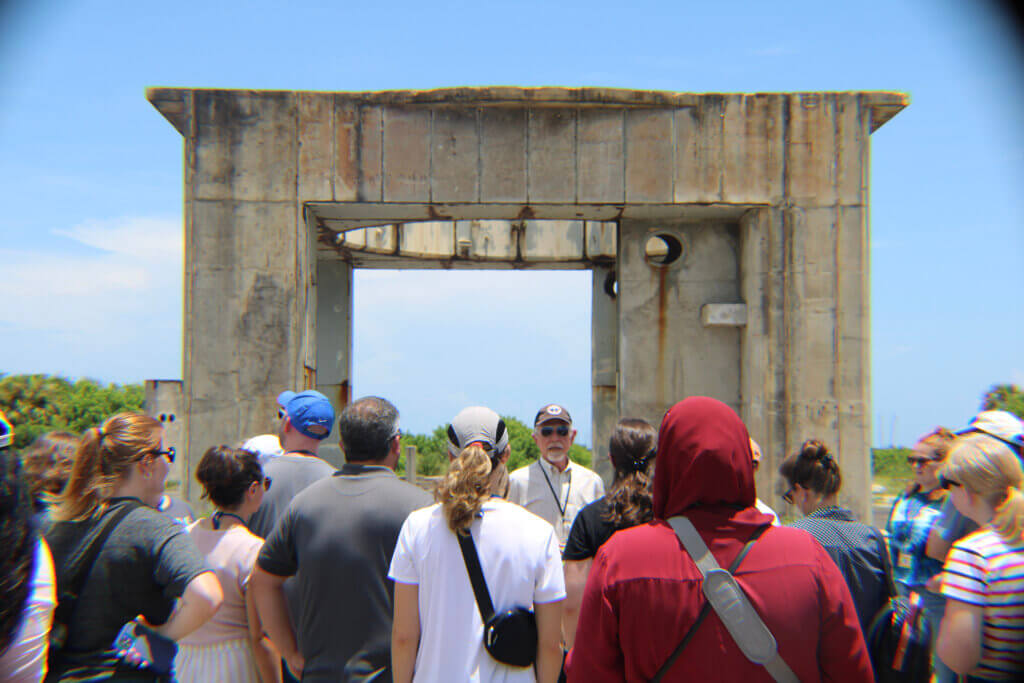
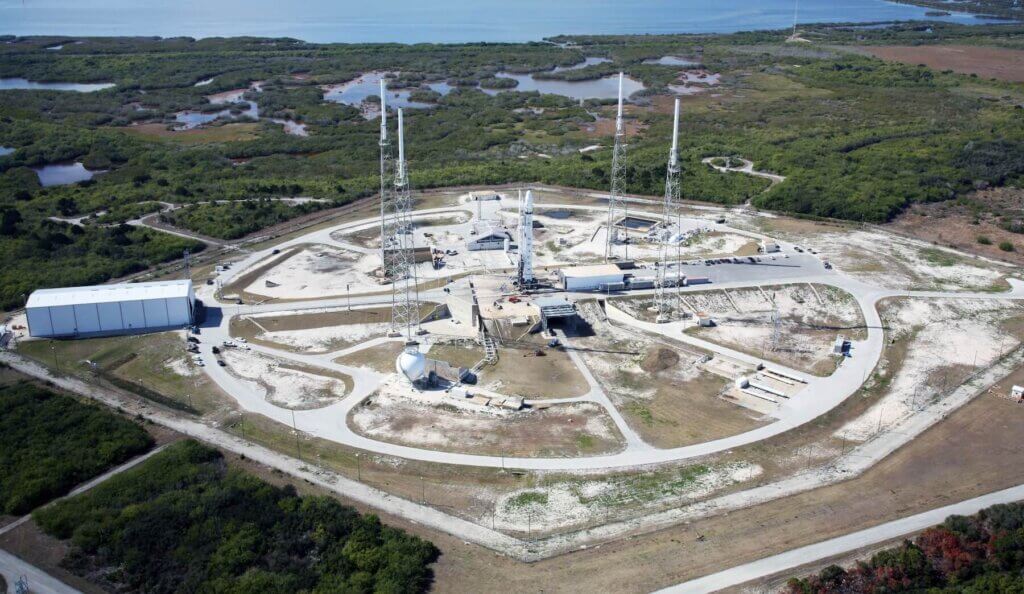
These two workshops, each with 30 educators, will use AMF as a “home base” from which to investigate landmarks associated with the American origins of space exploration, including the Vehicle Assembly Building and launchpads at the Kennedy Space Center, Cape Canaveral Space Force Station launch sites and museums, and multiple exhibitions and experiences at the Kennedy Space Center Visitor Center.

Participants will engage with historians, education specialists, and master teachers, as well as NASA astronauts, launch directors, and engineers to investigate these sites and give meaning to America’s scientific past through a focus on the human experience.

We hope you will consider joining us as we explore these frontiers!
The Space Age on the Space Coast has been made possible in part by a major grant from the National Endowment for the Humanities: Democracy demands wisdom.

Any views, findings, conclusions, or recommendations expressed in this website and associated programming do not necessarily represent those of the National Endowment for the Humanities.

Eligibility & Expectations

Review the information below before completing your application. When you’re ready to apply, please click the “Apply Now” button located at the bottom of this page. We look forward to working with you!

To be considered, you must submit a complete application as indicated on the individual project’s website. Prospective participants must follow the stated application and acceptance deadlines. In general, application extensions will not be granted. Any questions about applying should be directed to the individual project team. Participant eligibility criteria are determined by NEH. Application review and offer decisions are determined by individual project teams in accordance with NEH eligibility requirements.

You are eligible to apply if you are a:

– United States citizen, including those teaching abroad at U.S. chartered institutions and schools operated by the federal government;
– resident of U.S. jurisdictions; or
– foreign national who has been residing in the United States or its jurisdictions for at least the three years immediately preceding the application deadline.

You are not eligible to apply if you:

– are a foreign national teaching abroad
– are related to the project director
– are affiliated with the applicant institution (employees, currently enrolled students, etc.)
– have been taught or advised in an academic capacity by the project director
– are delinquent in the repayment of federal debt (taxes, student loans, child support payments, and delinquent payroll taxes for household or other employees)
– have been debarred or suspended by any federal department or agency
– have attended a previous NEH professional development project (Seminars, Landmarks, or Institutes) led by the project director

NEH does not require participants to have earned an advanced degree.

In any given year, an individual may attend only one Institute or Landmarks workshop.

J1 and F1 visa holders should confer with their sponsoring institution regarding their eligibility to receive a stipend from another institution.

If you are not an American citizen, you will need to fill out additional paperwork in order to be approved for entry into certain areas of the Kennedy Space Center.

To be considered for selection, applicants must submit a complete application as indicated on the project website.
Any questions about applications should be directed to the individual project team. kathleen@ncheteach.org

 In any given year, an individual may attend only one Institute or Landmarks workshop. Participants may not accept an additional offer or withdraw in order to accept a different offer once they have accepted an offer to attend an NEH Institutes or Landmarks program. Endowment programs do not discriminate on the basis of race, color, national origin, religion, sexual orientation, disability, or age.

Project teams and program participants must adhere to the Principles of Civility for NEH Professional Development Programs detailed here: https://www.neh.gov/grants/principles-civility

Stipends provide compensation to participants for their time commitment and help to defray participation costs, such as travel, program activities, lodging, and meals (for residential programs), and technical support (for virtual programs). For residential programs, participants cover their own costs for travel to/from a program, lodging, and meals. Stipends are taxable as income.

Project teams must not reduce participant stipends for project-related activities, lodging, or meal costs without prior approval. Project teams must not place contingencies (completing a lesson plan, completing a program evaluation, etc.) on the receipt of participant stipends.

Applicants who accept an offer to participate are expected to remain during the entire period of the program and to participate in its work on a full-time basis. If a participant is obliged through special circumstances to arrive after the beginning or depart before the end of the Institutes or Landmarks program, it shall be the recipient institution’s responsibility to see that only a pro rata share of the stipend is received or that the appropriate pro rata share of the stipend is returned if the participant has already received the full stipend.

Program Format1 Week2 Weeks3 Weeks4 Weeks
Residential & Combined$1,300$2,200$2,850$3,450
Virtual$650$1,100$1,425$1,725

The NEH requires project directors to collect anonymous participant evaluations at the conclusion of their programs. Unedited participant evaluation responses will be included in the project’s final report to the NEH and any future Institutes or Landmarks applications.

Project teams may opt to offer continuing education, in-service, or graduate credit. These opportunities sometimes require additional work by participants beyond the program, such as writing a research paper, and participants are responsible for associated costs or fees unless otherwise noted.

how to apply

Application Schedule

Application Deadlines and Notifications

Application Deadline: March 6, 2026 by 11:59 pm Pacific time
Applicant Notifications: April 6, 2026
Applicant Acceptance Deadline: April 17, 202
6

Application Checklist

Step 1: Complete the Online Application

Completed the online application (a Google Form) by clicking on the “Apply Now” button below. You will be asked to comment on the following three questions. We STRONGLY suggest that you draft your answers in a world processing program before entering them into the application form. Each question has a 250-word limit. Please share with us:
a) your interest in the subject of the workshop;
b) your special perspectives, skills, or experiences that would contribute to the workshop; and
c) how the experience would enhance your teaching or school service and be useful in your classroom or teaching environment.

Step 2: Attach a PDF Resume or Curriculum Vita

Attach a single .pdf file that includes a resume or curriculum vita.

Step 3: Confirmation

You should receive an email confirmation upon submitting the application.

Endowment programs do not discriminate on the basis of race, color, national origin, religion, sexual orientation, disability, or age. For further information, write to the Equal Opportunity Officer, National Endowment for the Humanities, 400 7th Street, SW, Washington, DC 20024. TDD: 202-606-8282 (this is a special telephone device for the Deaf).

Schedule-at-a-Glance

The Space Age on the Space Coast workshops will take place from July 12-17, and July 19-24, 2026. Each day of the program will focus on a relevant theme. Participants will work with  historians, education specialists, and NASA employees and astronauts to learn the history of the Space Coast, and will take experiential field trips related to the project’s themes. Throughout the workshop, participants will gather primary sources, historical context, and strategies for using place-based history in the classroom. They will use these resources to create primary source sets that will be posted to the project website.

Time

Activity

Speaker & Location

6:00-6:30

Registration

Courtyard Marriott Titusville

6:30-7:30 

Welcome and Introductions
Gather at the Program Hotel to check in to the workshop, meet fellow participants, and enjoy dessert. Learn  more about the daily photo challenge and take your first photos overlooking the Indian River. 

Courtyard Marriott Titusville

7:30-8:45

Workshop Launch!

NASA Launch Director Michael Leinbach (ret.) will share stories from his eleven-year tenure as the final Shuttle Launch Director at Kennedy Space Center. He was responsible for overall Shuttle launch countdown policy, planning, and execution activities, as well as the traditional pre-launch dinner, which proceeded every Shuttle mission.  

Courtyard Marriott Titusville

8:45-9:00

Reminders for Monday morning, bus schedule, instructions for accessing KSCVC, and Goodnight

Courtyard Marriott Titusville

Pre-Reading/Viewing: Dubcovsky, Alejandra. “Centering Native Stories in Florida History.” Recorded February 8, 2023. NCHE Webinar. https://ncheteach.org/Webinar-Post/Centering-Native-Stories-in-Florida-History 

U.S. Fish and Wildlife Service. “The Merritt Island Adventure.” Posted November 17, 2014. https://youtu.be/22IlBi3cR2I
Thematic Questions: Who lived on the Space Coast prior to the Space Age? What are some of the key events of the 19th and 20th centuries that shaped the region’s history and culture? How and Why did NASA select Florida’s coast as the launchpad of the country’s space exploration programs? What are History’s Habits of Mind? How did the Space Race reflect the political, technological, and ideological competition between the United States and the Soviet Union during the Cold War? What role did propaganda play in shaping public perceptions of the Space Race in both the United States and the Soviet Union? 
Daily Photo Challenge: Take your photo with a space-flown object at the Apollo/Saturn V Center. What did you choose to photograph and why?

Time

Activity

Speaker & Location

8:30 am

Bus departs hotel for Kennedy Space Center Visitor Center  (KSCVC) 

Courtyard Marriott Titusville

8:45-9:15

Pass through security gates at Kennedy Space Center Visitor Center (KSCVC) and (short) walk to the Astronauts Memorial Foundation (AMF) building

9:15-10:15

Warm-up: The Space Coast Before Space
Participants will explore primary sources that reveal the history of eastern Florida from the earliest Ais inhabitants through the early 20th century. We will collaborate to create a timeline of the region prior to the dawn of the Space age. 

Kristy Brugar & Lori Menning
AMF 

10:15-11:15

History’s Habits of Mind, and Creating Compelling Questions
Dr. Brugar will introduce History’s Habits of Mind.  Participants will work in small groups to use this framework to begin developing compelling questions based on topics we will study during the Landmarks Workshop. 
History’s Habits of Mind empower and enable individuals to: Grasp the significance of the past in shaping the presentPerceive past events and issues as they might have been experienced by the people of the time, with historical empathy rather than present-mindednessRead critically, to discern differences between evidence and assertion and to frame useful and appropriate questions about the pastInterrogate texts and artifacts, posing questions about the past that foster informed discussion, reasoned debate and evidence-based interpretationRecognize that history is an evolving narrative constructed from available sources, cogent inferences and changing interpretationsAppreciate the diversity of cultures and variety of historical contexts, as well as to distinguish elements of our shared humanityUnderstand the impact made by individuals, groups and institutions at local, national and global levels both in effecting change and in ensuring continuityRealize that all individuals are decision makers, but that personal and public choices are often restricted by time, place and circumstanceNegotiate a complex, often uncertain and ambiguous world, equipped with the appreciation for multiple perspectivesEngage in patient reflection and constant reexamination of the past and present.

Kristy Brugar
AMF 

11:15-11:30

Break

11:30-12:30

Introduction to the Space Age on the Space Coast  
Dr. Foster will explore the connections between the Cold War and the Space Race, with particular attention to why Kennedy Space Center came to be built on Cape Canaveral. 

Amy FosterAMF

12:30-1:30

Exploration of KSCVC and Lunch on your own (several restaurant options available at KSCVC)

KSCVC

1:30

Bus departs for Apollo / Saturn V Center from AMF

1:45-4:00

Apollo / Saturn V CenterTake a self-guided tour, or join project team members as we highlight key moments of the Space Race through artifacts, including: the development of the Saturn V rocket; the Apollo I tragedy; and the Lunar 9 Module and international reaction to the Moon landing. Participants will also have free time to explore additional exhibits at the center (and touch a moon rock!). Participants should plan to board a bus back to KSCVC by 4:00pm (You can take ANY bus back to the Kennedy Space Center.)

Apollo / Saturn V Center 

4:15-5:00pm

Reflection and discussion: Participants will have the opportunity to share something new or interesting they discovered on the first day of the workshop, as well as their Photo Challenge selections. How might these discoveries help refine the compelling questions developed on day one of the workshop? 

Lori Menning AMF

5:00pm

Wrap-up and reminders for Tuesday

Project TeamAMF

5:50pm

Bus loads in KSCVC parking lot and departs for return to Hotel

6:00

KSCVC Closes for the day

Reading/Viewing: Holt, Nathalia. Rise of the Rocket Girls. Little, Brown & Co., 2016. (Introduction to be read prior to the workshop.)

Howard, Clare. Recording of “Over the Blue and Green,” https://youtu.be/44N6ybyLWTs?si=pyniBw_GsLsBmhgE&t=123

Thematic Questions: How can we help students think critically about objects from the past? In what ways did the Space Race influence education and scientific research in the United States and other countries? What is the Vehicle Assembly Building, and what role has it played in launching people and equipment into space on missions of exploration? Where can we find examples of space exploration in multiple disciplines? How has the idea of “Space exploration” inspired art and storytelling?

Daily Photo Challenge: Take your photo in or around the Vehicle Assembly Building. What story does your photo tell?

Time

Activity

Speaker & Location

8:30 am

Bus departs hotel for Kennedy Space Center Visitor Center  (KSCVC) 

Courtyard Marriott Titusville

8:45-9:15 am

Pass through security gates at KSCVC and (short) walk to the Astronauts Memorial Foundation (AMF) building

KSCVC

9:15-9:45 am

Introduction to Rise of the Rocket Girls, assigning chapters to read for Wednesday’s “ABC Graffiti” exercise.

Kristy Brugar
AMF 

9:45-11:00

Dr. Brugar and Dr. Foster will lead participants through an exercise on teaching with artifacts. In small groups, participants will head outside to the Rocket Garden at KSCVC to analyze the exhibits and the stories they do (and do not) tell through their interpretive labels. 

Kristy Brugar & Amy Foster
AMF 

11:00-12:15

History of Presidential Leadership, Education, and Culture in the Space Race
Investigate the interplay between presidential leadership during the Space Race, education, and culture. We’ll focus on Presidents Eisenhower, Kennedy, and Nixon, and explore the growth of STEM education as a result of the Space Race. What effects has technology had on the Space Coast, including in literature and design?

Amy Foster
AMF

12:15-1:15

Exploration of KSCVC and Lunch on your own

KSCVC

1:15

Bus departs AMF for Behind-the-Scenes Tour of the Vehicle Assembly Building and Launch Complex 39DRESS CODE IN EFFECT (no shorts/skirts, or open-toed shoes) SECURITY CLEARANCE REQUIRED

1:15-3:45

Tour of the Vehicle Assembly Building and bus tour of Launch Complex 39 (site of many launches, including those from the Apollo program, the space shuttle program, and the current Artemis program). We will see the crawler that transports vehicles from the VAB to the launch pad, and drive adjacent to the Crawlerway.

Bus Tour 

3:45-4:00

Return to AMF and Break

4:00-5:30

Cosmic Reflections: STEAM and Space Exploration 
Participants will explore primary sources that provide evidence of the profound impact that space exploration has on multiple disciplines and creators.  We will investigate examples from literature, art, music, and architecture, and more! We’ll begin by listening to a musical piece composed by NCHE staff member Clare Howard after her experience at the 2024 Landmarks Workshop.

Lori MenningAMF

5:30-5:45

Wrap up, reflection, and reminders for Wednesday

Project TeamAMF

5:50

Bus loads in KSCVC parking lot and departs for return to AMF 

6:00

KSCVC Closes for the day

Pre-Reading/Viewing: Molia, David Miguel. “Bringing the Moon to Mankind: The Civil Rights Narrative and the Space Age. In NASA and the Long Civil Rights Movement, edited by Odom, Brian C. and Stephan P. Waring, 44-57. Gainesville: University Press of Florida, 2019.

Thematic Questions:  How can experiencing a place impact our understanding of justice movements? How did NASA’s growth and development in the South intersect with the racial segregation and desegregation efforts of the Civil Rights era? How does the long history of the civil rights movement intersect with the Space Coast? In what ways did the experiences of Black professionals at NASA during the Civil Rights Movement highlight broader societal inequities in education and employment opportunities?

Daily Photo Challenge: Take a photo that represents the experience of animals and space exploration (multiple opportunities at the Space Force Base). Which animal’s story spoke to you and why?

Time

Activity

Speaker & Location

8:30 am

Bus departs hotel for Kennedy Space Center Visitor Center  

Courtyard Marriott Titusville

8:45-9:15 am

Pass through security gates at KSCVC and (short) walk to the Astronauts Memorial Foundation (AMF) building

KSCVC

9:15-9:45

Reflection and discussion. In this mid-week reflection participants can share something they:Loved?Learned?Are Looking forward to?

Everyone with Dr. Brugar & Lori Menning
AMF 

9:45-10:45

NASA and Racial Justice
Dr. Foster will highlight NASA’s role in fostering racial justice and equality on the Space Coast, from Ralph Abernathy’s protests of the moon launch to the pioneering work of black astronauts like Colonel Frederick Drew Gregory and Dr. Mae Jemison. 

Amy FosterAMF 

10:45- 11:00

Break

11:00-12:00

ABC Graffiti: Rise of the Rocket Girls
Dr. Brugar will guide participants in an interactive activity using secondary sources associated with women and space exploration, including Nathalia Holt’s Rise of the Rocket Girls. This activity offers participants opportunities to work collaboratively to identify key words, phrases, and ideas in a text, which can be used to spark discussion and inquiry among students. 

Kristy BrugarAMF 

12:00-1:00

Exploration of KSCVC and Lunch on your own

KSCVC

1:00

Bus departs for Cape Canaveral Space Force StationDRESS CODE IN EFFECT (no shorts/skirts, or open-toed shoes); SECURITY CLEARANCE REQUIRED

1:00-4:00

Tour of Space Force StationOur tour leader (a staff member from the base) and AMF Director Thad Altman will introduce us to sites across the station, including:The 150-year-old Cape Canaveral Lighthouse, now owned by the U.S. Space Force and still actively used for navigation by the U.S. Coast GuardLaunch Complex 14, site of the 1962 launch site of the Friendship 7, the vehicle in which John Glenn became the first American to orbit the EarthLaunch Complex 26, now a museum dedicated to the 1958 launch of the United States’s first satellite Explorer I Launch Complex 34, site of the 1967 Apollo I tragedy

Space Force Station

4:00-5:30

Guest Speaker: Winston Scott
Winston Scott is a former NASA astronaut and retired U.S. Navy captain. Scott was selected by NASA and reported to the Johnson Space Center in 1992. He logged 24 days, 14 hours, and 34 minutes as a mission specialist in space during his two missions STS-72 Endeavour and STS-87 Columbia. Scott performed three spacewalks totaling 19 hours and 26 minutes.
In addition to being a naval aviator and an astronaut, Winston Scott is a musician and has a second degree black belt in Shotokan karate. He graduated from Florida State University in 1972 with a Bachelor of Science Degree in Music and also has a Master of Science Degree in Aeronautical Engineering. In July 2005, Scott published the book, Reflections From Earth Orbit.

5:30-5:45

Wrap up, reflection, and reminders for Thursday

Project TeamAMF 

5:50

Bus loads in KSCVC parking lot and departs for return to AMF 

6:00

KSCVC Closes for the day

Readings: Foster, Amy E. Integrating Women into the Astronaut Corps: Politics and Logistics at NASA, 1972–2004. Baltimore: Johns Hopkins University Press, 2011.


Wright Jean, Sew Sister: The Untold Story of Jean Wright and NASA’s Seamstresses. New York: Tilbury House Publishers, 2023. 

Thematic Questions: How has the inclusion of women in space programs evolved since the mid-20th century? How have social and cultural attitudes about gender impacted women’s participation in space exploration? How have women contributed to the development of space technologies, such as spacecraft design, robotics, or space science instrumentation? What unique health challenges do women face during long-term space missions compared to men, and how are these being addressed?

Daily Photo Challenge: Take a photo with Space Shuttle Atlantis. How will you use this photo to introduce students to some aspect of the history of the space shuttle program?

Time

Activity

Speaker & Location

8:30 am

Bus departs hotel for Kennedy Space Center Visitor Center  

Courtyard Marriott Titusville

8:45-9:15 am

Pass through security gates at KSCVC and (short) walk to the Astronauts Memorial Foundation (AMF) building

KSCVC

9:15-9:45

Biography – Five Profiles in Space 
How can we use picture book biographies with students at every level to diversify the narrative surrounding space exploration? Sample texts will include:
Sew Sister: The Untold Story of Jean Wright and NASA’s SeamstressesClassified: ThevSecret Career of Mary Golda Ross, Cherokee Aerospace EngineerMission to SpaceMae Among the StarsSally Ride: A Photobiography of America’s Pioneering Woman in Space

Kristy BrugarAMF

9:45-11:15

The Evolution of Women in Space Exploration
Dr. Foster will describe the early Soviet successes in putting women into space, and why it took NASA so long to catch up. She will also discuss the difficulties and opportunities that came along with preparing the first women for space, and the role of women in the space program today.

Amy FosterAMF

11:15-11:30

Break

11:30-12:15

Building Primary Source Sets That Work
In this session, we will discuss how to find primary sources to use in your classroom from repositories such as Chronicling America, the National Archives, Google Arts and Culture, and NASA digital resources. Dr. Brugar shares strategies for  building a strong document set when crafting an inquiry lesson. Participants will work together in small groups to create primary source sets around one or more of the compelling questions designed on day one. 

Kristy BrugarAMF

12:15-1:30

Exploration of KSCVC and Lunch on your own

AMF

1:30-4:30

Expanding the Astronaut Corps: Space Shuttle Atlantis  NASA icon, Jean Wright, will lead participants through an activity that highlights evidence of greater opportunities for women within the space program. She will discuss her role as a seamstress at NASA KSC during the Shuttle Program, and share examples of the different fabrics, threads, and products NASA seamstresses created. Participants will then walk to the Atlantis Pavilion where Jean will provide a guided tour of Atlantis and highlight her own contributions to the shuttle’s structure.  

  Jean Wright     AMF   
 Atlantis Pavilion at        KSCVC 

4:30-5:30

Exploration time. Participants can explore the Atlantis Pavilion or other exhibits at the KSCVC. Return to AMF by 5:30 for end-of-day announcements. [Take a picture with a new friend]

KSCVC 

5:30-5:45

Wrap up, reflections, and reminders for Friday

AMF

5:50

Bus loads in KSCVC parking lot and departs for return to AMF 

6:00

KSCVC Closes for the day

Pre-Reading/Viewing: Maher, Neil. “Space Age Environmentalism.” February 27, 2020.  NCHE webinar. https://www.youtube.com/watch?v=vCstStZB_0A

Thematic Questions: How can technology advance while preserving/protecting environments? What will the future astronaut corps look like? What does the future hold for space exploration, and what role(s) will Kennedy Space Center play? Is space exploration a good investment? 

Daily Photo Challenge: Take a photo of a space-flown object or an innovation developed through space-themed technology. What does your object tell YOU about the future?

Time

Activity

Speaker & Location

8:30 am

Bus departs hotel for Kennedy Space Center Visitor Center  

Courtyard Marriott Titusville

8:45-9:15 am

Pass through security gates at KSCVC and (short) walk to the Astronauts Memorial Foundation (AMF) building

Everyone
AMF 

9:15-10:30

KSC: The Spaceport of the Future
Together with project team members, participants will explore cutting-edge innovations developed by NASA and its commercial partners. We’ll enter the “spaceport of the future” and embark on a simulated space journey to explore destinations including Mars, Trappist-1, a Horsehead Nebula, Saturn, and Jupiter.

Project TeamGateway PavilionKSCVC

10:30-11:30

Learn more about how the designers of Kennedy Space Center navigated the construction and early implementation of a technologically advanced facility while preserving the surrounding environment. 

Amy FosterAMF

11:30-12:30

The Economics & Ethics of NASA
Is space exploration a good investment? Can we afford not to explore our universe? Spotlight educator Lori Menning will guide participants in an investigation of a variety of primary sources that explore the social, economic, and political pros and cons of space travel and exploration. 

Lori MenningAMF

12:30-2:00

Lunch together @ AMF
During the latter half of our lunch break, Dr. Brugar will lead a discussion of inquiry lessons. Participants will be encouraged to share their ideas for lessons and offer feedback and suggestions to their peers. 

Kristy Brugar
AMF

2:00-3:00

NASA NowA representative from Exploration Ground Systems (EGS), based at NASA’s Kennedy Space Center in Florida, will describe their work to develop and operate the systems and facilities needed to process and launch rockets and spacecraft for NASA’s Artemis missions. They will lead a discussion and Q&A on current NASA events and developments. Possible topics could include: the proposed return of the American astronauts to the surface of the Moon in 2027, the creation of a Martian settlement, and the development of space tourism.

NASA Exploration Ground Systems 

3:00-3:30

Next Steps and Final Thoughts
Stipend informationWorkshop evaluation: complete by August 1, 2026When & how to submit lesson plans: submit by August 1, 2026Conference opportunities – NCHE 2027 in Providence, RIFinal reflections

3:30-6:00

Shuttle bus will return to the hotel based on participants’ needs.

6:00

KSCVC Closes for the day

Kathleen Barker
Project Director

Clare Howard
Communication Coordinator

Amy Foster
Project Historian

Kristy Brugar
Project Education Specialist

Lori Menning
Project Spotlight Educator

Chris Albritton
Vice President and COO, Astronauts Memorial Foundation

Logistics

Participants are responsible for their own accommodations. We have reserved a room block at the Courtyard by Marriott in Titusville (6245 Riverfront Center Boulevard, Titusville, FL 32780). Rooms are $170/night plus tax. This hotel is located approximately 10 minutes from the Kennedy Space Center Visitor Complex. Our room block is large enough that everyone can have their own room, if they wish. However, if you’d like to share a room, we can help you find a roommate once all participants have been accepted in the spring.
While we encourage everyone to stay at the hotel in order to build a sense of camaraderie, you are not required to stay at the workshop hotel, and you may choose to stay at another hotel or rental in the area. There are many options in Titusville, Port Canaveral, or in Cocoa Beach.

Airports

Orlando International Airport – https://orlandoairports.net/ (MCO) more flight options at this large airport. It is an easy drive due east from the airport to Kennedy Space Center (@ 45 miles takes 45 minutes).

Melbourne International Airport – http://www.mlbair.com/ It is a smaller airport with fewer flights but is served by Delta and American. It is located 48 miles from Kennedy Space Center.

Sanford Orlando Sanford International Airport – https://flysfb.com/ This is a smaller airport north of Orlando. Primary airline is Allegiant. It is about 48 miles from Kennedy Space Center.


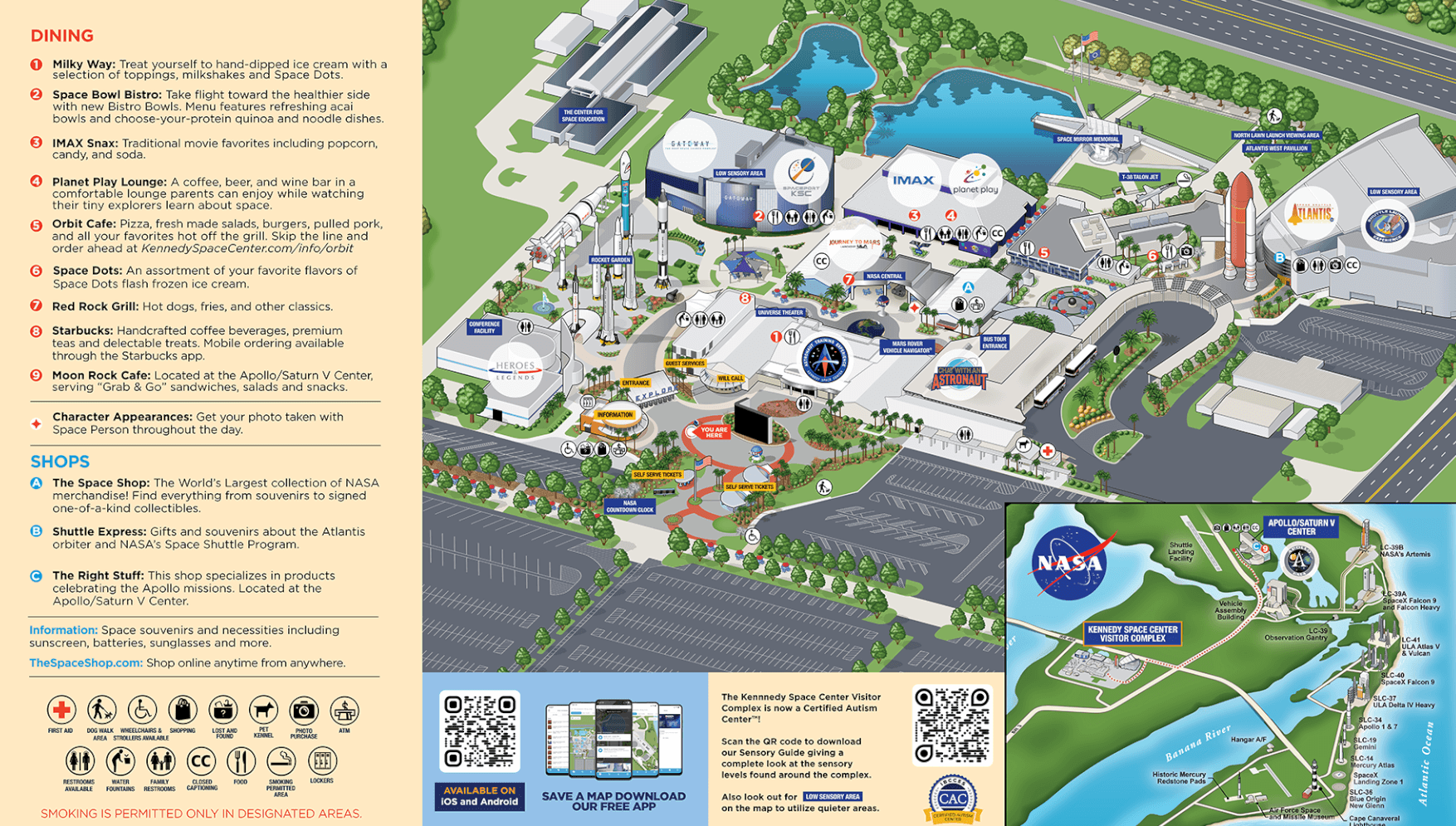
Directions to the Kennedy Space Center Visitor Complex: The website includes directions and a map.
https://www.kennedyspacecenter.com/info/maps
Parking and transportation to Kennedy Space Center Visitor Complex

There is no public transportation to this location. We will provide a shuttle bus from the workshop hotel to KSC in the morning, and a return shuttle to the hotel from KSC at the end of the day. You are also welcome to rent or bring a car and drive yourself to KSC. Parking will be free to workshop participants.

Participants will be responsible for their own meals. Light refreshments will be provided at AMF during our sessions.
There are a variety of options for lunch on your own at the Kennedy Space Center Visitor Complex.(https://www.kennedyspacecenter.com/info/dining), or you may choose to bring lunch.

The pace of the workshop will be intense and will involve long days. We will be visiting several outdoor venues, so prepare for variable weather conditions. Be prepared for air-conditioned classrooms in addition to walking outdoors in the sun or possibly rain during site tours. Please dress comfortably.

NOTE: Open-toed shoes/sandals are not allowed during site visits to Cape Canaveral Space Force Base. Pants or long skirts that cover the entire leg are also required on those days.

As a professional organization, NCHE is pleased to offer you a certificate verifying 40 hours of Continuing Education with the successful completion of the workshop.

Site Visits

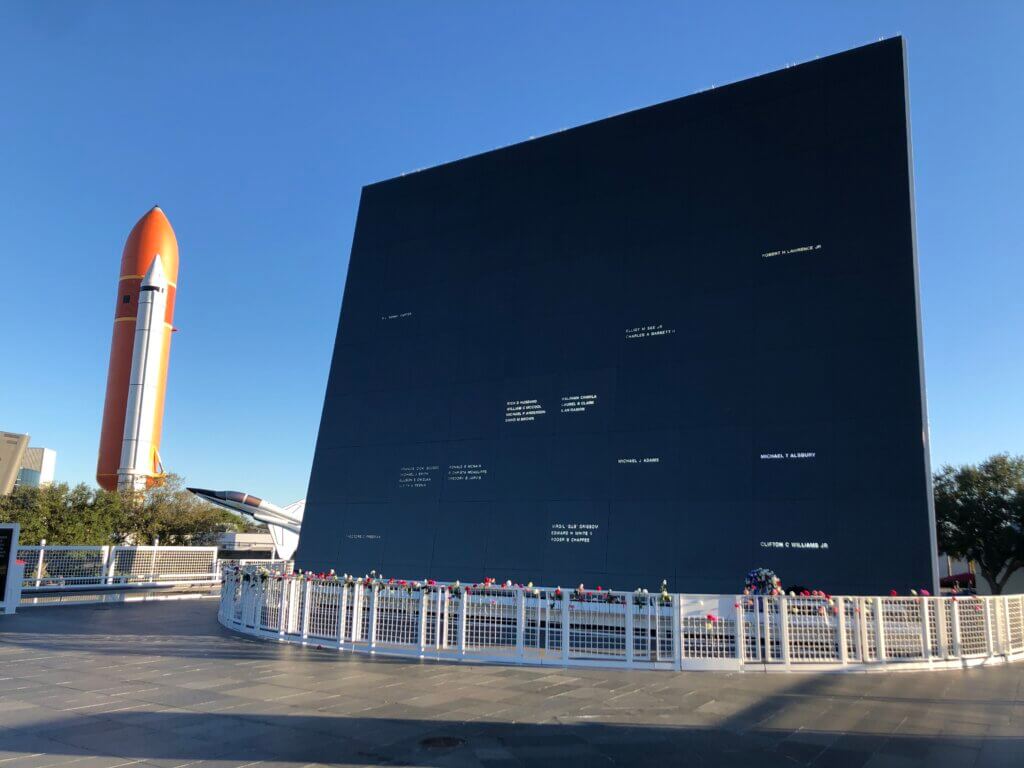
The Astronauts Memorial Foundation honors the past and inspires the future. Our astronauts are national treasures. Each year at the Kennedy Space Center Visitor Complex in Florida, AMF recognizes their sacrifice on a Day of Remembrance at the Space Mirror Memorial, a 42-foot high by 50-foot wide polished granite monument that glows with the astronauts’ names.

In addition to paying tribute to our fallen astronauts, AMF also inspires future generations of scientists, technologists, engineers, and mathematicians through its Center for Space Education. The Center is a place where students, teachers, and mentors experience building rockets, robotic competitions, and other hands-on learning activities. They also see and experience America’s space program first hand. When children see how to apply what they’re learning to something as exciting as space exploration, their minds get fired up, and their future gets brighter.

As the birthplace of American human spaceflight, Kennedy Space Center is a major central Florida tourist destination. Its stellar history begins with space pioneers circling the Earth in capsules smaller than a VW Bug to launches of monumental space shuttle expeditions. Astronauts have floated in open space, delivered satellites, conducted laboratory experiments, repaired space telescopes, and built a space station. The Space Mirror Memorial is located on the grounds of the Kennedy Space Center Visitor Complex.

https://www.amfcse.org/

Kennedy Space Center Visitor Complex is organized into Mission Zones where attractions and tours are grouped by chronological era. From the dawn of space exploration to current and ongoing missions, you can get an up-close, hands-on feel for the story of humans in space. Explore the history NASA’s Shuttle program and stand nose-to-nose with the Space Shuttle Atlantis; Investigate the Apollo missions to the Moon and touch a Moon rock; and take a simulated ride to a space port of the future.


https://www.kennedyspacecenter.com/

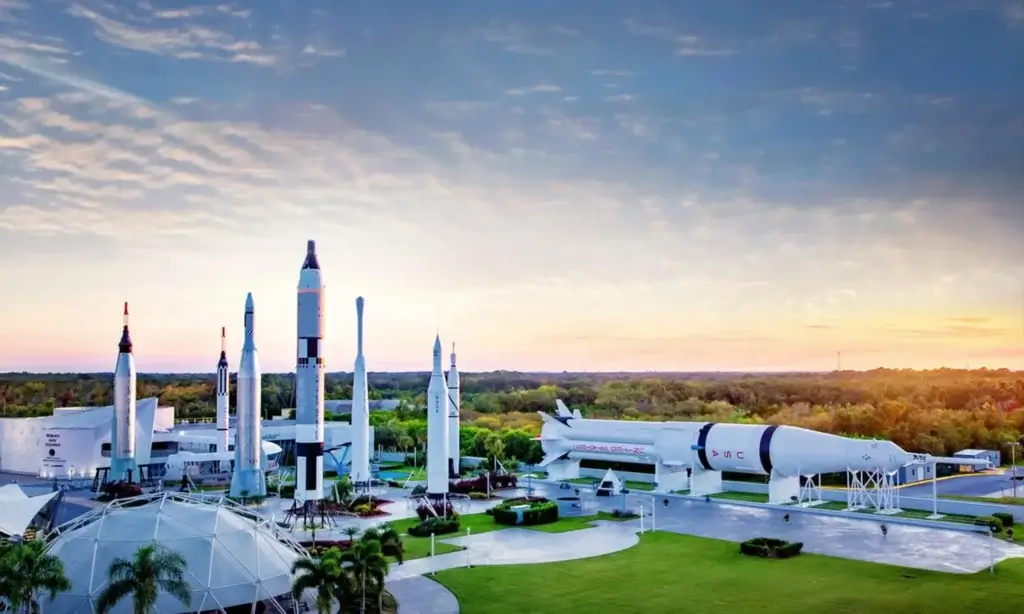
A Mercury-Redstone 3 rocket launched the aspirations of an entire country in 1961, when Alan Shepard completed the first U.S. human space flight. NASA’s Mercury, Gemini and Apollo programs are represented by this garden of giants, not just as engineering feats of technology, but also as tribute to the scientists and engineers who turned dreams of spaceflight into reality.
While the visitor complex has grown exponentially over the years, the Rocket Garden has remained recognizable since it was first erected. When you tour among these giants, you are walking among incredible, authentic machines that pioneered America’s space exploration. Most of the rockets you see today are real, though never flown in space. Remember: in the early days of America’s space program, we did not reuse or retrieve rockets once they launched.


https://www.kennedyspacecenter.com/blog/rocket-garden

Cape Canaveral Space Force Station is home to the United States Air Force Space Command’s 45th Space Wing. This is where many of today’s rocket launches take place, but it’s also the launch site of many American space pioneers including the first U.S. Earth satellite, the first U.S. astronaut, and the first U.S. astronaut in orbit, to name a few.

https://ccspacemuseum.org/sites/cape-canaveral-air-force-station/

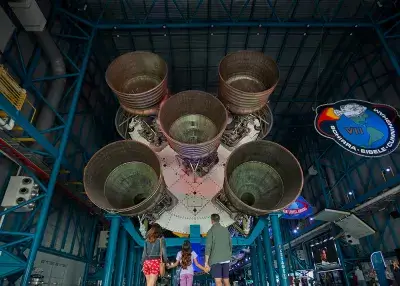
There are moments in American history that unified our country and shifted our culture. The Apollo Moon landings represent one of these pivotal periods. The Apollo/Saturn V Center pays homage to the people and machines that made the improbable possible and the future seem bigger than we ever dared to dream. There, stand in amazement under the gigantic Saturn V, the largest rocket ever flown. Through new interactive and engaging exhibits, relive the wonder and excitement of the Apollo era. This one-of-a-kind attraction celebrates the unprecedented achievement of putting humans on the Moon and the awe felt in that moment by all humankind.

https://www.kennedyspacecenter.com/explore-attractions/race-to-the-moon