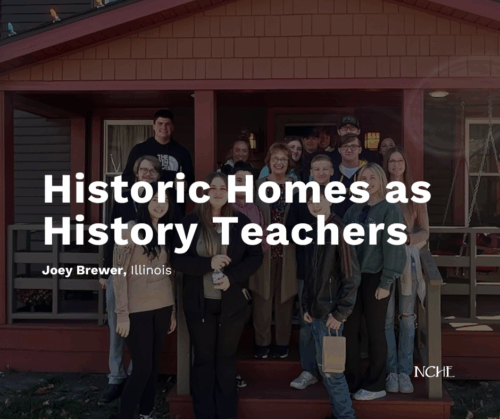
At Cuba High School in rural downstate Illinois, I have learned that some of the most powerful history lessons happen when we step outside the classroom. One of the most memorable examples came when longtime resident Kathy Spillner invited my students to tour her family’s historic home, known in town as the “Red Geranium House.” For many students, it had always been just another house they passed on their way to school. But the tour transformed their perspective.
Mrs. Spillner had left our town of Cuba years ago to work as a guidance counselor in the Chicago area, yet like many small-town residents, she kept her roots in her small community and returned in retirement. This classroom experience allowed her to welcome students not only into her home, but into her family’s history. The activity also helped students discover how stories of everyday families form an essential part of our community’s past.
She had carefully preserved artifacts that told both her family’s story and the broader history of our town. In this sense, the Red Geranium House itself became a primary source. Its rooms and objects extended our classroom learning, reinforcing historical thinking skills such as sourcing, contextualization, and interpretation. Students studied the original deed to the house, complete with signatures from long-gone residents. They examined her grandfather’s high school diploma and family photographs spanning generations. In doing so, they learned how to connect individual lives to wider historical narratives and to see how ordinary people shape community history.
The house made a strong impression. Students talked for weeks about details that revealed both beauty and care. Her attention to preserving the home taught them the value of memory and pride in place; lessons that were definitely not included in textbooks.
But perhaps the deepest lesson came from Mrs. Spillner herself. She reminded students that history is not only about remembering the past but also about living responsibly in the present. Civic duty, she explained, begins with caring for your home, looking out for neighbors, and preserving the stories that bind a community together. She also modeled what it means to be a gracious host. This was a skill not listed in any school improvement plan, yet is essential for shaping the kind of students who will carry our community forward.
For my students, the Red Geranium House will always stand as proof that history feels most personal when it is lived, shared, and preserved in our own backyard. They may not always remember the lessons I teach in the classroom about dates or documents, but they remember the feeling of walking through that house and the stories it carried. And of course, the cookies she baked for us didn’t hurt in making the experience unforgettable.