
Taking History Outside the Classroom Walls
By Kevin Cline
Several years ago, a dedicated group of history-loving students asked, “Our school offers a club for art, science, foreign language…why not history?” That conversation sparked what would become our school’s first history club. From the start, we worked together to develop a mission statement to help ensure that our club would not just be “another club.” The students came up with a mission “to take the study of history outside the classroom walls.” Over the past eighteen years, our club has grown to be amongst the largest student organizations in the school, has offered students countless and varied opportunities to explore their interest in history, and has been nationally recognized multiple times.
The success of the student group lies in the students themselves. This is “our” club, and each year a dedicated group of student leaders help to plan and facilitate the club’s activities. These activities have run a gamut of options, including: site visits to state-wide historical sites, including the Levi and Catherine Coffin Home, the site of the Battle of the Mississinewa from the War of 1812, and Conner Prairie, a fantastic local history museum and experience; we have also hosted guest speakers, movie nights, trivia nights. In October, members of our club will be taking our first out-of-state trip to Boston! Our club has also worked to foster a love for local history within our small town through local history tours and, most recently, an effort to commemorate the World War I service of a local resident, May Berry.
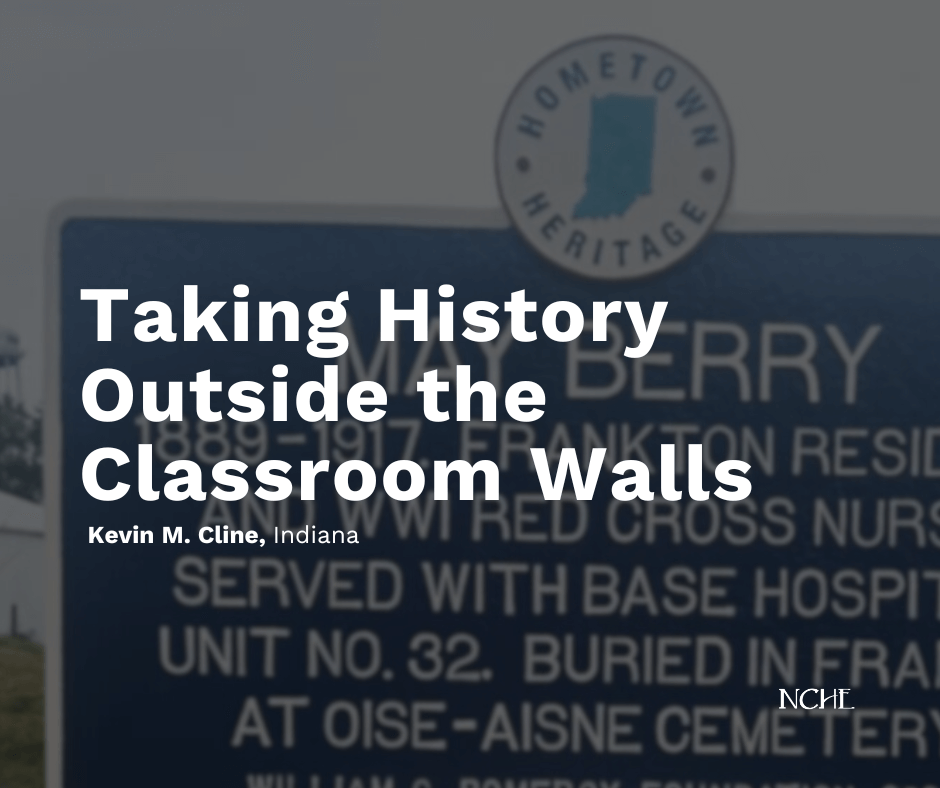
Ms. Berry was a resident of Frankton until moving to Indianapolis in 1910 to pursue training as a nurse at Deaconess Hospital. Ms. Berry graduated from that program in 1913 and remained in Indianapolis to serve as a nurse, until the United States entered World War I in 1917. Upon that, Ms. Berry volunteered her service immediately, and was assigned to Base Hospital 32, which was founded in Indianapolis but would move then to the town of Contrexeville in France, and was supported largely through financial contributions from the Eli Lilly Company. During its one year of active service in World War I, Base Hospital 32 would care for over 9,000 soldiers. Regretfully, Ms. Berry would contract pneumonia and pass on December 30, 1917, and her death would be reported by General John J. Pershing on January 1, 1918. Ms. Berry’s body lies in the Oise-Aisne American Cemetery in France. Ms. Berry is credited as being the first American Red Cross nurse to lose their life on foreign soil. Over the course of last school year, students in the History Club worked to secure funding for a historical marker.
Our work on this project began with research into the life of Ms. Berry, including the collection of primary sources that would prove her connection to our town and her service in the war. Students were able to find newspaper articles detailing her tragic death, photographs of both her and her resting place in France, and a memorial headstone in a small local cemetery. Our work also led us to apply and receive a grant from the William Pomerory Foundation, which would fund the marker itself. Students were also required to present at town board meetings to secure permission for the installation of the marker. Last September, during our small town’s local festival, we were honored to unveil the finished marker, one that we hope is just the first of similar markers to honor the great history of our town. The work not only gained a greater appreciation for the history of our town, but also some valuable experience in the work of local government.
Early on, our club joined forces with the National History Club, an organization that offers national support for clubs around the country. The National History Club sponsors a student award each year, along with an honor society, the National History Scholars Society. Our club also began a chapter of this honorary, becoming the first in the state of Indiana. Since then our club has offered students a chance to not only explore their love of history, but gain recognition for it and the hard work done in our classrooms. The National History Club also sponsors club awards, and our club has, on three occasions, been recognized for our work as one of the top chapters in the country.
Sharing the work of our History Club has been one of the most fulfilling experiences of my career, and many of our members have on to continue both their love of history and service to their community. Past members have pursued teaching careers in social studies and have worked at museums near and far. Many others have returned to many of the sites with their own families. Personally, the best experiences have come in sharing these opportunities with the students, to see a real appreciation for history grow in them, to hear a student say about history, “Hey, that’s pretty cool!” For more information on starting such a club at your school, check out the National History Club at https://www.nationalhistoryclub.org/.